

There are endless content marketing strategies you can use to build your brand and grow your audience.
You can create a blog, you can start a podcast, you can launch a YouTube channel.
But there’s one strategy that is often overlooked, and that’s guest blogging. Guest blogging is the practice of blog writing for another publication in your industry. It’s a powerful way to get your name and your message in front of a new audience, and it’s one of the most effective ways to build your authority and your credibility.
But guest blogging is not as simple as it sounds. You can’t just write a blog post, send it to a few publications, and expect to get published. The top-tier publications in your industry are inundated with guest post submissions every single day. They have a high bar for quality, and they are not going to publish just any old blog post.
If you want to get published on a top-tier publication, you have to be strategic, you have to be professional, and you have to be persistent.
I’ve been on both sides of the guest blogging equation. I’ve pitched and been published in publications in my industry, and I’ve also been the editor of a publication that receives hundreds of guest post pitches every month. I know what it takes to get a guest post accepted, and I know why most end up being rejected.
In this post, I’m going to share with you my best practices for guest blogging with a step-by-step guide to finding the right publications, pitching your ideas, and writing a guest post that will get published.
The Benefits of Guest Blogging
 Before we dive into the best practices, let’s take a quick look at some of the benefits of guest blogging. Why should you even bother with it in the first place? Here are just a few of the reasons why guest blogging is one of the most powerful content marketing tools in your arsenal:
| Benefit of Guest Blogging | Explanation |
| Reaching a new audience | When you write a guest post for another publication, you are getting your name and your message in front of a whole new audience. This is a great way to build your brand and grow your following. |
| Building authority and credibility | When you are published on a well-respected, high-traffic publication, it’s a powerful endorsement of your expertise. It shows that you are a thought leader in your industry, and it builds trust with your audience. |
| Increased traffic to your website | Most publications will allow you to include a link to your website in the blog or within your author bio. This is a great way to drive traffic to your website and generate new leads. |
| Improved SEO and SGE | When you get a backlink from a high-authority publication, it’s a powerful signal to Google and AI search engines that your website is a credible source of information. This can help you rank higher in search results and attract more organic traffic. |
A Step-by-Step Guide to Guest Blogging Best Practices
Now that you understand the benefits, let’s take a step-by-step look at writing a blog and publishing as a guest.
Step 1: Find the Right Publications
The first step is to identify the right publications for your brand. Easier said than done: Tech Business News reports there are more than 600 million blogs worldwide, as of 2026. That’s almost a third of all websites, and a lot to sort through.
How do you narrow down your search? You want to partner with publications in your industry, with a similar target audience, and with a high bar for quality.
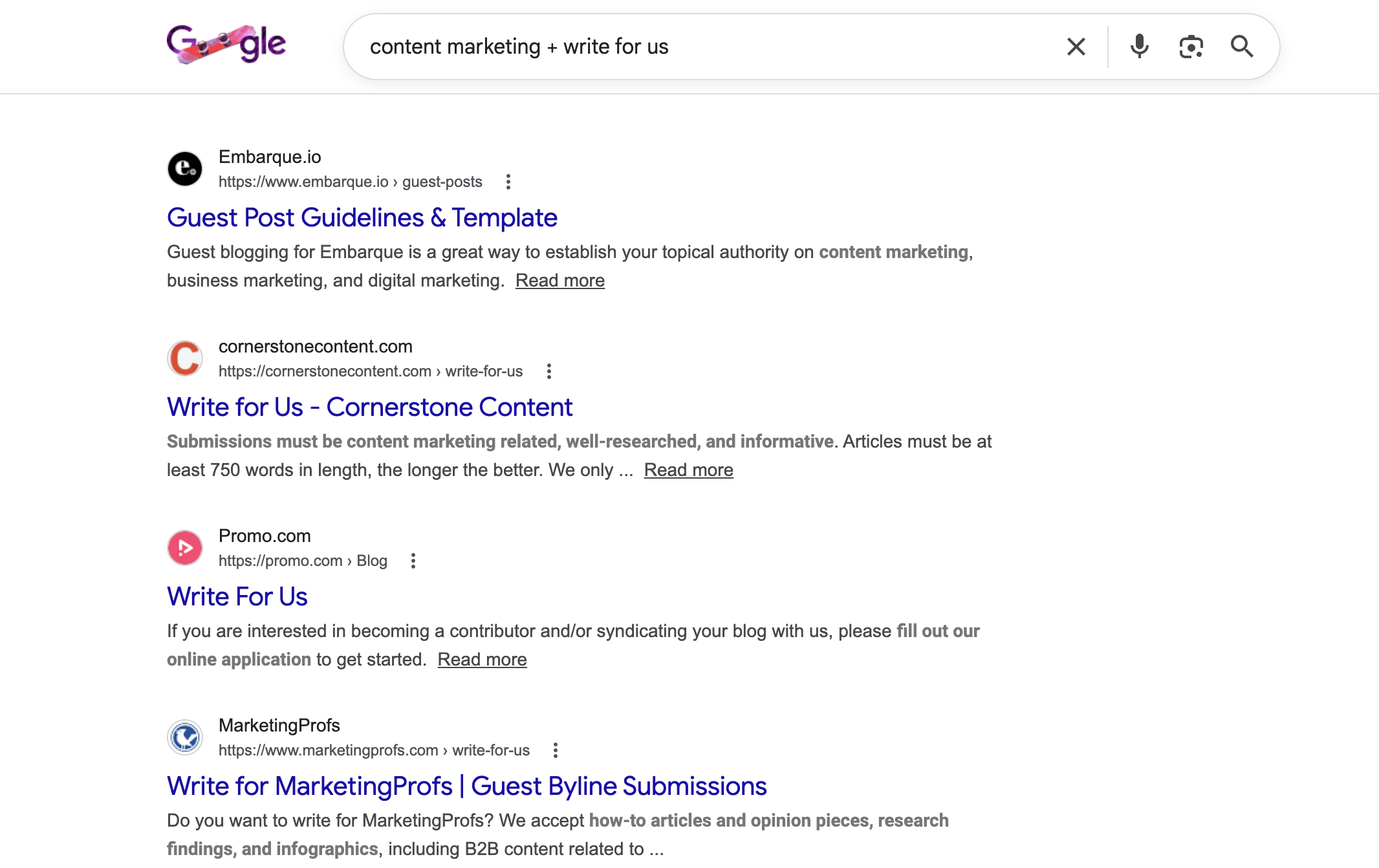
A good way to find these publications and learn their guest blogging best practices is to do a Google search for “[your industry] + guest post” or “[your industry] + write for us.” You can also use a tool like Ahrefs or BuzzSumo to find the top publications in your industry.
You can see in my example below, I searched my industry “content marketing” combined with the phrase “write for us” and pulled up 4 potential guest post opportunities.
 Step 2: Study the Publication
Once you’ve identified a few potential publications that might be a fit for your blog writing, it’s time to do your homework.
Read their blog, follow them on social media, and sign up for their email list. Get a feel for their tone, their style, and their audience. What kind of content do they publish? What are their most popular posts? Do they have any tips for content teams interested in guest blogging?
The more you know about the publication and their content, the better you will be able to tailor your pitch to their needs.
Step 3: Come Up with a Great Idea
Using what you learned in step 2, the next step is to come up with a great idea for a guest post.
Your idea should be original, it should be relevant to the publication’s audience, and it should be something that you are uniquely qualified to write about. An easy way to begin generating ideas is to look at the publication’s most popular posts and see if you can come up with a new angle or a fresh perspective.
Step 4: Write a Killer Pitch
Your pitch is your one and only chance to make a good first impression. It should be short, it should be personal (but professional), and it should be to the point. Here’s a simple formula you can use:
- Start with a personal connection. Mention a recent blog post you enjoyed or a social media post that resonated with you. This shows that you’ve done your homework on the publication and you’re not just sending out a generic pitch to multiple potential partners.
- Introduce yourself and your idea. Tell them who you are, what you do, and what you want to write about. Be sure to explain why your idea is a good fit for their audience.
- Provide a few potential headlines. This shows that you’ve put some thought into your idea, making it easier for the editor to visualize your post on their blog.
- Include a few links to your previous work. This shows that you’re a credible writer or company with a track record of producing high-quality content.
Step 5: Write a Great Guest Post
If your pitch is accepted, it’s time to write your guest post. Be sure to follow the publication’s guidelines, and be sure to write a post that is well-researched, well-written, and provides a ton of value to the reader. And don’t forget to include a clear and compelling call to action in your author bio.
Step 6: Promote Your Guest Post
Once your guest post is published, it’s time to promote it. Share it on your social media channels, send it to your email marketing list, and link to it from your website. The more you promote your guest post, the more traffic it will get, and the more value it will provide to the publication.
You’ve unlocked 10% off your first bill ?
Looking for outstanding copy that drives conversions? Book a free chat about your project and get 10% off your first bill when you quote “BLOG”.
Build Your Authority With Guest Blogging
Guest blogging is one of the most effective ways to build your brand, your audience, and your authority. But blog writing is not as simple as it sounds. It takes time, effort, and a strategic approach to following guest blogging best practices.
However, one successful guest blog can lead to a continued partnership with the publication or opportunities with new partners, further increasing your brand’s reach. By following the best practices in this guide, you can increase your chances of getting published on top-tier publications and reaping the many rewards of guest blogging.
Ready to take your content marketing to new audiences? Book some time with me today and let’s talk about how to make your content a break-out star.
Looking to hire a copywriter?
Our team of expert writers is poised pen-ready for your brief. Book a free call and let’s have a chat about how we can get that project off the ground.
Frequently Asked Questions
It depends on the publication, but a good rule of thumb is to aim for at least 1,000 words. The top-ranking posts in Google are typically over 2,000 words long. But the final count is always at the discretion of the publication’s team.
No, you should never pay to guest post. Credible publications will never ask you to pay to be published, as doing so would damage their own authority. If a publication is asking you to pay, it’s a red flag.
It depends on your goals and your resources. I recommend starting with one or two guest posts per month and then scaling up from there as needed to meet your goals.
Don’t take it personally. Editors are busy people who receive many pitches. If your pitch is rejected, it doesn’t mean it’s a bad idea. It just means it’s not a good fit for that particular publication at that particular time. Try pitching it to another publication, or try coming up with a new idea.
The key to getting a lot of engagement on your guest post is to write a great blog and to promote it heavily. Be sure to respond to all the comments on your post, and be sure to share it with your own audience.
The Benefits of Guest Blogging
A Step-by-Step Guide to Guest Blogging Best Practices
- Step 1: Find the Right Publications
- Step 2: Study the Publication
- Step 3: Come Up with a Great Idea
- Step 4: Write a Killer Pitch
- Step 5: Write a Great Guest Post
- Step 6: Promote Your Guest Post